
The picture below was taken exactly six years ago – six years ago yesterday to be precise. My stepfather had just dropped me at Cambridge North Station. I was on the way to Stansted, to catch a flight to Athens. It was October 2020, in between the Covid lockdowns.
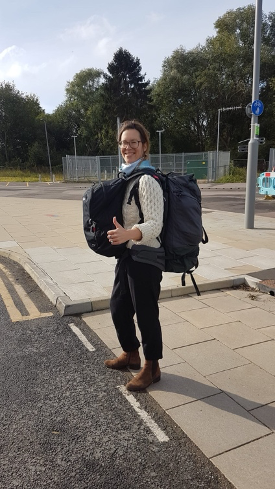
I’d crammed everything I needed for six months of study into those two bags. Don’t I look funny? My stepdad laughed at me kindly. You look like a tortoise with two shells, he said. Most of what I had in those bags was books. I was about to embark on an MA in Creative Writing, which due to the lockdown was happening, for the first time in the university’s history, fully remotely.
I’d been excited about the prospect of studying at the University of East Anglia, famed for its creative writing programmes. I was overjoyed at the thought of spending a year reading books, honing a craft I’d long neglected, and spending my time in between the cafés, cobblestones and medieval churches of Norwich. Mist over the fens. Reminders of W.G. Sebald everywhere.
But it wasn’t to be. I’d made a few desultory attempts to find lodgings in the city in early September, but the flats I liked were snapped up quickly, a second lockdown seemed likely, and suddenly, I thought, I don’t really want to spend my time indoors in Norwich for six months, in subpar and expensive accommodation, the cobblestones and Sebald’s ghost notwithstanding.
As it happened, a Greek friend had inherited a large apartment in Athens. She offered me a room there, half in jest (or so I thought). I can’t go to Athens, I ruminated. Lockdown in England was bad enough. But in a foreign country? And the Greeks had been notoriously strict, my family had watched in dismay when the first flights were suspended in March 2020. As excited as we were when the country tentatively opened up to tourists in July, it seemed only a matter of time before infection levels would rise, and the country would close its borders again.
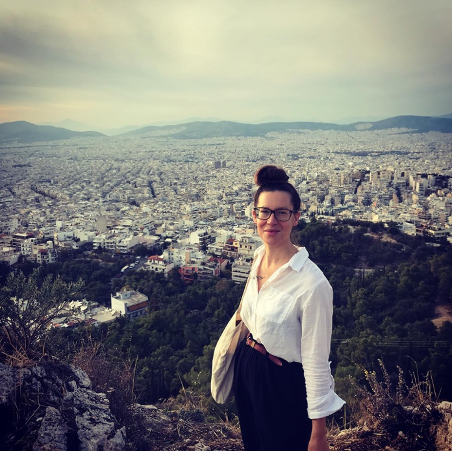
There’s something I should mention here – Greece wasn’t entirely foreign to me. I have had a strange distant-yet-close relationship with the country for most of my life. My grandmother, who was Russian, emigrated to the country in 1931 and lived there until her death in 2008. My mother spent her childhood there, before coming to the UK permanently. My father is a very English Classics teacher. I grew up in the U.K., but every summer we’d visit my grandmother in her tiny house on the island of Hydra. Many of my parents’ domestic rows revolved around the correct pronunciation of ancient Greek vowels and diphthongs. I studied Classics myself at university – by which I mean the languages and cultures of Greece and Rome – but I’ve often felt ambivalent both about modern Greece and the disproportionate, bordering-on-obsessive adulation many westerners have for the idea of ancient Greece. In any case, I’d never lived abroad and my modern Greek was very basic – just a few words and phrases cloaked in a deceptively good accent.
What is it that compels us to do anything? The ancient philosophical term is hormē, which means impulse. I still cannot fully unpick my reasons for taking up my friend’s offer and moving into a room in her apartment in Athens – to a city I didn’t really know, in the middle of a global pandemic. I do remember that when I mooted the plan, lots of people said it was a brilliant idea. I also had a very kind and energetic boyfriend, who actually encouraged me to go (the relationship didn’t last; his gift to me was his vicarious enthusiasm that got me off my bum and on that plane).
So, six years ago today, I crossed Athens in a cab from my hotel near the Acropolis and walked the last stretch up the tree- and café-lined slope of Fokionos Negri to my friend’s apartment. I’ll write more about Kypseli in future posts, but this central-yet-still-undiscovered-by-tourism neighbourhood was a revelation for me. It was green and cheerful, with two main pedestrian thoroughfares and cafés and markets aplenty. The area was diverse, with older Greek inhabitants living alongside longstanding migrant communities from Ethiopia and West Africa, whose restaurants, salons and churches provided more than just a colourful distraction: they were community hubs that allowed the diaspora to feel at home.
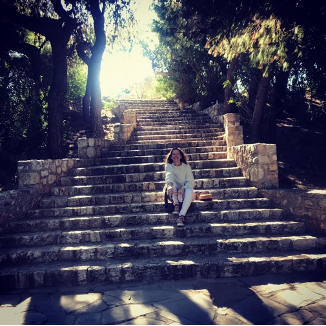
My friend’s apartment sat alongside the central fountains of Fokionos Negri, and the bedroom I chose needed no alarm clock. When the waters were turned on in the morning it was my cue to wake up and draw the heavy silk curtains. Our landlady didn’t live with us; the apartment was an inheritance that was both an honour and a burden. It was very, very big, full of lovely artwork, furniture and books, but rather cumbersome to own. In the mid-decades of the twentieth century, Kypseli had been a rather upper-crust neighbourhood – but after waves of migration starting in the late 1990s, and years of financial crisis, it was hard to find a Greek family who could afford – let alone wanted – to rent a full 350sqm (nearly 3,800sqft) in a superannuated part of the capital.
I met Donald J. Robertson, my flatmate, as soon as I arrived. He’d been vaguely and grandly mooted beforehand as a philosopher and a writer. I wasn’t sure what to expect but he certainly wasn’t the shy academic type. Bearded and tattooed, with a penchant for heavy metal, he was an inveterate night-owl and a man of austere ways: he drank black coffee, water with vinegar, and did intensive skipping to Metallica every morning. He was, and is, a person entirely without pretension, as obsessive about ancient philosophy as he is skilled in modern psychotherapy, tirelessly hardworking and able to take criticism with humour and good grace. I quickly dubbed him the “Scottish Socrates” because of his accent and his propensity for asking difficult questions and confronting me, kindly, with bits of my personality I didn’t like. He would ask me “what’s your telos?” and christened me “Fronto” after Marcus Aurelius’ philosophy tutor (I’d been teaching Classics at schools in the U.K. before Covid).
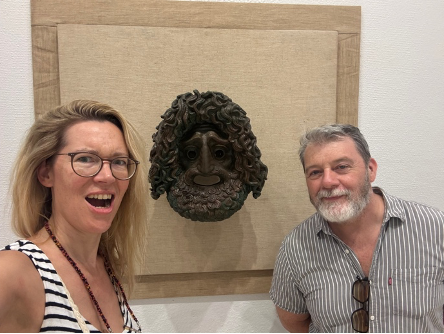
In my next post, I will write about what friendship meant to the Greeks and Romans. But before I get to that, let’s just state the obvious. A good friend has the power to change your life. Not just because they support and encourage you when you don’t believe in yourself, but because they provide a model, a paradigm. We all need people to emulate. And it’s easier to emulate people we like. There are very many things I wouldn’t have had the courage to do but for Donald, like deciding to move to Greece permanently, or writing a book – and every time our friendiversary comes around I’m reminded of this and taken back to those early months in Athens: the ideas shared over lockdown walks and a glass of masticha, the sight of snow on the Acropolis, and the excitement of being somewhere old that felt entirely new.
Welcome to my new Substack, where I’ll be writing twice weekly about ancient philosophy, creative writing, and life in Athens.